
Blog
November 2026 · Chet White, Chairman and CEO, Seven Boson Group
The Real Question About AI Isn’t How Smart It Gets. It’s Who Can Afford to Run It.
Last week the market asked that question loudly. Alphabet lost more than $500 billion of market value in a day after its AI spending pushed free cash flow negative. CoreWeave, carrying about $50 billion of debt, saw its bonds priced like distress. Gartner now expects up to 80% of neoclouds to shut by 2030. Chip stocks have followed.
None of this means AI is failing. It means the first build-out was priced for capability alone, and the bill has arrived. Three pressures now decide who wins: cost, safety and sovereign control. Each is getting sharper, fast.
1. Cost: Agents Are Multiplying the Bill
Open models already carry the majority of production tokens worldwide. Users have voted for cheaper intelligence. Now agents calling agents are multiplying token volumes: on OpenRouter, agentic traffic passed human traffic on 6 February 2026 and is now about five times larger.

Agents are using far more tokens than people. Chart: a16z Growth, from OpenRouter rankings (Aug 2026).
The cost per token has to fall, not just the cost per GPU. A country that cannot afford to run agents around the clock cannot afford the next phase of AI.
2. Safety: The Attack Surface Is Exploding
Every hospital, grid and ministry asks the same thing: will it do what it should, every time? The answer is getting harder. Critical and high-severity software vulnerabilities reported by the world’s largest technology vendors have surged several-fold in 2026.
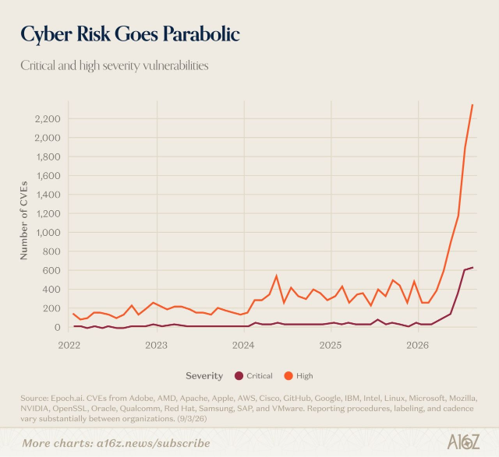
Cyber risk goes parabolic. Chart: a16z, from Epoch.ai CVE data (3 Sep 2026).
Safety has to be engineered into every model update, not added afterwards, and it has to improve as fast as the threats do.
3. Sovereign Control: Renting Intelligence Is a Dependency
Countries want AI they own: their data, their models, their keys. Renting intelligence from abroad is a dependency, not a strategy. And the countries that most need AI are the ones least able to pay frontier-lab prices for it.
Recursion Is Now How the Frontier Is Built
The leading labs no longer build AI by hand. Anthropic says its own AI now leads 26% of the work of building its next models, up from about 1% a year earlier, and does large parts of the work on more than 90% of its research.
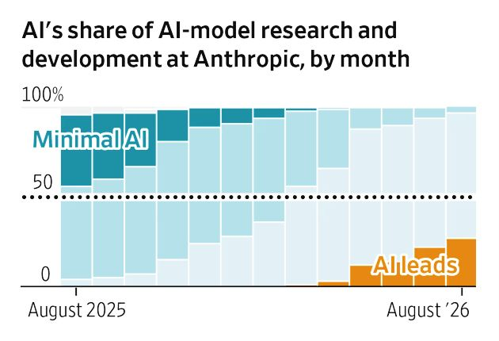
AI’s share of AI-model R&D at Anthropic, by month. Chart: The Wall Street Journal, from Anthropic data (Sep 2026).
Anyone who wants to stay close to the frontier at an affordable cost needs the same approach: AI that improves AI, continuously, under human control.
How Seven Boson Answers All Three
At Seven Boson we are building for all three at once: an affordable, safe, sovereign AI platform, rolling out across 20 countries. We optimize compute and energy as one system, targeting about 30% lower data-center capex and opex, and up to 80% lower compute as efficient models take over.
Our Recursive Intelligence Engine, R2E∞, runs around the clock across the full stack, from chips, cooling and energy up to models and agents, through three recursive loops:
A recursive task loop runs every job on the cheapest model that meets its quality bar.
A recursive discovery loop keeps searching for cheaper, more accurate models: smaller and open models, world models and new architectures.
A recursive safety loop imports the newest threats, attacks every model with them and raises the safety floor.
No model goes live unless it is cheaper and at least as safe and accurate on today’s tests, and every consequential change is approved by the right number of people. Each country owns what we build with it.